

No.1 - Hipp-toggle Wall Clock
In 1863, Matthäus Hipp patented the Hipp-toggle mechanism - an extremely efficient way of triggering the impulse to the pendulum. Its use became popular in electrical clocks, using a solenoid to to deliver the impulse, however there is one known to use a weight driven mechanism to mechanically impulse the pendulum. Due to evidence suggesting that the piece in question was a test bed, it is likely that it pre-dates the patent. No.1 will be the second weight-driven Hipp-toggle known to have been made.
I have made several major alterations to the original design, adding two wheels to the train to increase the duration, adding Harrison's maintaining power, and moving the impulse movement to below the pendulum bob.

The impulse movement, to be positioned underneath the pendulum at the bottom of the case. The weight line leads out of the movement's left to a secondary barrel before going to the top of the case and into the backboard.
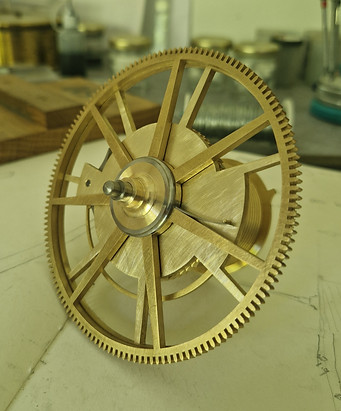
The reverse of the driving mobile, showing the maintaining power spring, dovetailed into the great wheel, held in place with the retaining cap and acting on the winding click spring's steady pin.

A view of the impulse carriage locking nut and rating nut, with blued steel index. The rating nut will be hand engraved with 5, 10, 15 and 20.

The underside of the pendulum bob spacer and rating index. The screw is the smallest component in the clock so far, with a 0.65mm thread. I made the die myself from thin gauge plate.

Wheels from the dial movement with pinions undercut, and leaves and ends polished. The train is driven by the the pendulum moving a pair of hinged pallets that count through a 30 pin wheel.

A hardened steel filing jig, milled on the Schaublin 102, for producing identical pins for the pin wheel. The 1mm brass wire is held in place by a perpendicular taper pin.


The jig for setting the pins. The semi-circular hole holds the pin firmly when the screws are tightened while the plate against the flat allows the pin to be aligned with the centre. Force is applied to the semi-circular flat on the pin rather than the end to avoid distorting them.

Holes broached to be a neat press fit with the pins an half-round centre stud for orientation. The pins were pressed in completely by hand to avoid distorting the rim.
The dial movement with wheels between plates. The dial will display hours and minutes with subsidiary seconds at 6 o'clock.